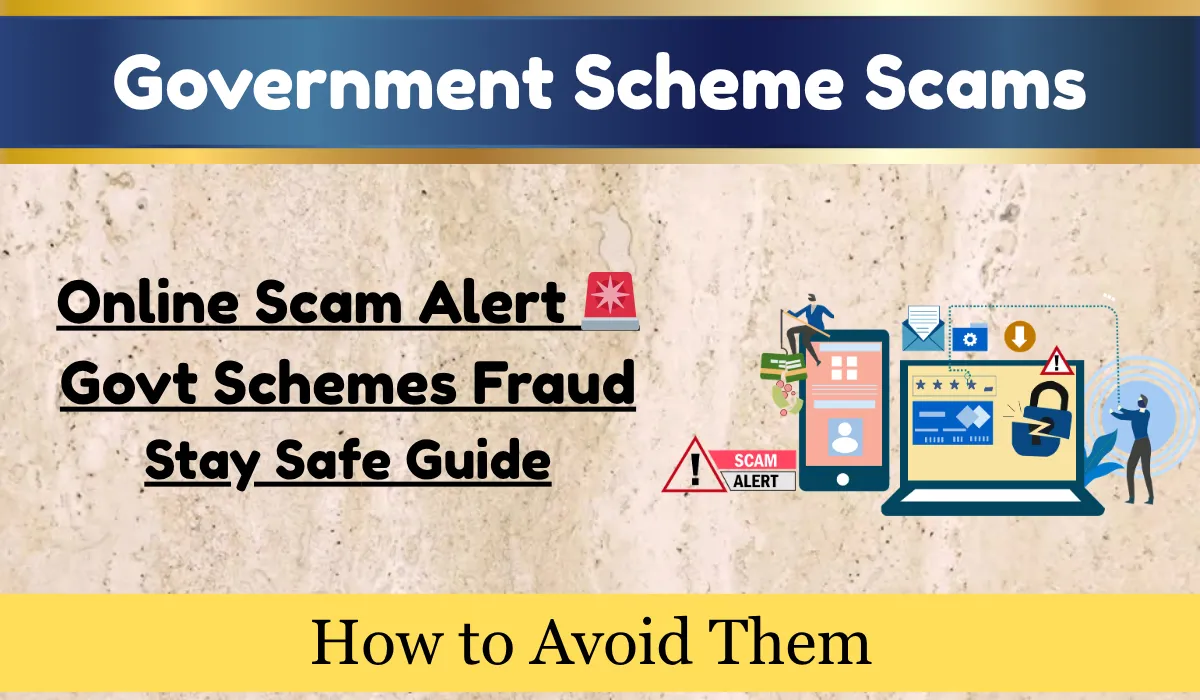
Common Online Scams in Government Schemes 2026 — How to Identify & Avoid Fraud | Complete Safety Guide
Why Government Scheme Scams Are on the Rise in India
India’s government schemes — from PM Awas Yojana and PM Kisan Samman Nidhi to Ayushman Bharat, E-Shram, and Ration Card updates — benefit hundreds of millions of citizens. But this massive scale also attracts an equally large network of fraudsters who exploit citizens’ trust in these schemes to steal money, personal data, and Aadhaar-linked bank access.
In 2024–25, the National Cyber Crime Reporting Portal (cybercrime.gov.in) recorded lakhs of complaints related to government scheme fraud. The scams have evolved far beyond simple fake calls — today’s fraudsters build convincing fake websites, send official-looking WhatsApp messages, create fake forms that steal Aadhaar and OTP, and even set up fake “helpline” numbers that rank higher in Google searches than official numbers.
This complete guide covers every major type of government scheme scam currently active in India, explains exactly how each scam works, lists the warning signs, and gives you a concrete action plan to protect yourself and report fraud if it happens.
10 Most Common Online Scams Targeting Government Scheme Beneficiaries
Fraudsters create websites that look exactly like official government portals — same logo, same layout, same colour scheme. They use domain names like pmkissan.co.in, pmayonline.in, or ayushmancard.org that appear legitimate at first glance. These sites ask you to enter your Aadhaar number, bank account, and OTP — then use this information to drain your bank account or sell your data.
Targeted Schemes: PM Kisan, PMAY, Ayushman Bharat, Ration Card, E-Shram, PM Vishwakarma
You receive a call or SMS claiming your PM Kisan, Ration Card, or Ayushman Bharat card will be blocked unless you complete an “urgent KYC update.” The caller asks you to share your Aadhaar number, bank account details, and the OTP that arrives on your phone. Once you share the OTP, your bank account is instantly emptied. No government scheme ever asks for OTP over phone.
Targeted Schemes: PM Kisan, Ration Card, Ayushman Bharat, EPF/PF, LPG subsidy
Fraudsters send WhatsApp messages (often forwarded through family/friends groups) claiming you can get free ration, Rs. 6,000 PM Kisan instalment, free gas cylinder, or a PMAY house by filling a form. The link takes you to a phishing site that collects your personal and bank details. Some messages ask you to “share with 10 friends to activate your benefit” — which spreads the scam further. WhatsApp is the most widely used channel for government scheme scams in India today.
Common Message Types: “Free gas cylinder for all families,” “PM Kisan 18th instalment link,” “Ayushman card download link,” “Free laptop scheme 2025”
Fraudsters call posing as EPFO (Employees’ Provident Fund Organisation) officers, informing you that your PF account has been frozen or that a new rule requires immediate update of your Aadhaar/bank details. They direct you to a fake EPFO website or ask you to share your UAN number, password, and OTP. Once they have access to your UAN account, they initiate a withdrawal or change your linked bank account and steal your entire PF savings. Many victims are ex-employees who are unaware of recent EPFO digital processes.
Agents at Common Service Centres (CSCs), local shops, or online portals charge money to “register” you for government schemes — even for schemes that are completely free to apply for. They charge Rs. 200–2,000 as “processing fees,” “government fees,” or “form fees” for PM Kisan, PMAY, Ayushman Bharat, or E-Shram registration. All legitimate government scheme registrations at CSCs are either free or have a fixed nominal charge of Rs. 30–50 — never hundreds or thousands. Any agent charging more than this is committing fraud.
Fraudsters use SEO tactics and paid ads to push fake helpline numbers to the top of Google search results for queries like “PM Kisan helpline number,” “Ayushman Bharat customer care,” or “EPFO toll free number.” When you call these numbers, the person pretends to be an official government representative and then tricks you into sharing OTP, bank details, or making a payment to “process your complaint.” Always find helpline numbers from the official .gov.in or .nic.in website — never from random Google results.
A caller posing as a government officer or bank official asks you to install an app like AnyDesk, TeamViewer, or QuickSupport on your phone to “help fix your scheme registration problem.” Once installed, the scammer gains full control of your phone screen — they can see your banking apps, UPI PINs, OTPs, and passwords in real time. Within minutes they transfer money from all your accounts. This is one of the most financially devastating scams because the fraudster has complete device access. Never install any remote access app on instruction from an unknown caller.
Messages claim your Aadhaar needs to be urgently updated or linked to your ration card, bank account, or government scheme — or your benefits will stop. A link is provided that leads to a fake UIDAI-lookalike website. The form asks for your Aadhaar number, date of birth, mobile number, and OTP. Once submitted, your Aadhaar profile is used for SIM swapping or to impersonate you for financial fraud. UIDAI only sends official communications through SMS from 1947 (official UIDAI short code) — never via WhatsApp or email links.
SMS or WhatsApp messages announce you have “won” Rs. 25 lakh in a government scheme lottery, a free car, or a large cash prize from schemes like Narendra Modi Yojana, Digital India Lottery, or Pradhan Mantri Sukh Samridhi Yojana (names that sound official but do not exist). To claim the prize, you are asked to pay “processing fees,” “GST,” or “transfer charges” in advance — usually via UPI or online transfer. Once paid, the scammer disappears. No government scheme ever runs a lottery or asks for payment to release a reward.
Fraudsters call claiming to be Ayushman Bharat representatives and offer to send a “new upgraded Ayushman Gold card” or activate hospital benefits. They ask for your Aadhaar number and OTP to “verify” eligibility. In some cases, they ask you to visit a specific “empanelled” hospital where they charge you for treatments under the scheme — even though you are not actually registered. Some scammers also steal real Ayushman Bharat card details to make fraudulent insurance claims with hospitals. Check your real Ayushman eligibility only at beneficiary.nha.gov.in.
Universal Red Flags — Warning Signs That It’s a Scam
Whether it’s a call, an SMS, a WhatsApp message, or a website — these red flags apply universally. If you notice even one of these signs, stop immediately and do not share any information.
.gov.in or .nic.in. Sites ending in .com, .in, .co.in, .org, or .net claiming to be government portals are fake — even if they look identical to official sites.Official Website URLs — Know the Real vs. Fake
Always bookmark these official URLs. Before entering any information on a government website, verify the URL character by character. Scammers use look-alike characters — for example, replacing “l” with “1” or “o” with “0”.
| Government Scheme | Official Website (Real) | Example Fake URLs (Do NOT Visit) |
|---|---|---|
| PM Kisan Samman Nidhi | pmkisan.gov.in | pmkissan.in, pmkisan.co.in, pm-kisan.com |
| PM Awas Yojana (Urban) | pmaymis.gov.in | pmayonline.in, pmawas.co.in, pmay-apply.com |
| PM Awas Yojana (Rural) | pmayg.nic.in | pmaygramin.in, pmayg.com |
| Ayushman Bharat / PMJAY | beneficiary.nha.gov.in | ayushmancard.org, ayushmanbharat.in |
| EPFO / PF Account | epfindia.gov.in | epfoindia.in, epf-india.com, epfo-online.org |
| Aadhaar / UIDAI | uidai.gov.in | aadhaar-update.in, uidaionline.co.in |
| E-Shram Portal | eshram.gov.in | e-shram.co.in, eshramcard.in |
| National Cyber Crime | cybercrime.gov.in | — |
| India Government Portal | india.gov.in | — |
| DigiLocker | digilocker.gov.in | digilocker.in, digi-locker.com |
Scheme-Wise Scam Patterns — What to Watch Out For
Fake KYC update calls claiming instalment will stop. Fake PM Kisan beneficiary status links. WhatsApp messages claiming “18th instalment released — click to get.” Fake helpline numbers in Google. Official site: pmkisan.gov.in
Fake PMAY registration agents charging Rs. 500–2,000. Fake subsidy release calls asking for bank OTP. Fake PMAY selection list links on WhatsApp. Official site: pmaymis.gov.in
Fake Ayushman Gold card offers. Calls to “verify” hospital eligibility while stealing Aadhaar. Fake empanelled hospital lists. Fraudulent insurance claims using stolen card data. Official site: beneficiary.nha.gov.in
Fake EPFO calls claiming account freeze. Fake portal links to update bank details. UAN and password theft. Advance fee to “process” withdrawal claim. Official site: epfindia.gov.in
Fake E-Shram registration sites charging fees. WhatsApp messages claiming “Rs. 2 lakh accident insurance released — click to claim.” Fake E-Shram card download links collecting Aadhaar. Official site: eshram.gov.in
“Free gas cylinder” WhatsApp forwards. Fake Ujjwala 2.0 registration links. Calls asking bank details to transfer “LPG subsidy arrears.” Fake gas agency agents charging connection fee. Official site: pmuy.gov.in
How to Protect Yourself — 10 Safety Rules You Must Follow
What to Do If You Get Scammed — Step-by-Step Action Plan
Official Helpline Numbers — Save These in Your Phone Right Now
Important Links
Frequently Asked Questions — Government Scheme Scams
Conclusion — Knowledge Is Your Best Protection Against Government Scheme Fraud
Online scams targeting government scheme beneficiaries are sophisticated, widespread, and growing more convincing every year. But awareness remains the single most powerful defence. Every scam in this guide — regardless of how technically sophisticated — ultimately relies on the victim sharing critical information voluntarily. Once you know what to look for, you become significantly harder to defraud.
Share this guide with your family, friends, and community — especially those in rural areas who are active government scheme beneficiaries. Every person who reads this and understands these scams is one fewer victim. Yuva Safar is committed to keeping every citizen informed, safe, and empowered.